How to Choose the Right Digital Marketing Agency for Your Real Estate Business?

Digital Transformation in Gurgaon Real Estate: Trends, Buyer Behaviour, and Strategic Insights
Sections Included
- Introduction: The Digital Revolution in Gurgaon Real Estate
- Why Digital Marketing is Non-Negotiable for Realtors
- Graph 1: Real Estate Marketing Budget Allocation
- Graph 2: Conversion Rate Comparison Across Channels
- Graph 3: Homebuyer Search Behaviour
Introduction: The Digital Revolution in Gurgaon Real Estate
- Gurgaon (Gurugram) has undergone a remarkable transformation over the past decade. Once a satellite city, it is now one of India’s most dynamic and premium real estate markets. According to recent market data, Gurugram’s luxury housing market has surged dramatically, with apartments priced at ₹1 crore and above accounting for 62% of total sales in the first nine months of 2025, up from 52% in 2024. This represents a fundamental shift in buyer demographics and expectations.
- However, this growth brings intense competition. Realtors, property developers, and land investors in Gurgaon face an increasingly sophisticated buyer base — one that begins their property journey not in sales offices, but online. The modern property buyer is searching Google for “real estate near me,” scrolling through Instagram for visual inspiration, comparing listings on multiple portals, and expecting virtual tours, instant responses, and personalized follow-ups.
- For your real estate business to thrive in this environment, you need a digital marketing partner who understands not just marketing in general, but the unique nuances of property sales, buyer psychology, and the Gurgaon/Gurugram market specifically.
- This guide provides five essential questions to ask any agency before hiring — questions that will help you separate true experts from generalists, and ensure your investment drives real, measurable results
Why Digital Marketing is Non-Negotiable for Gurgaon Realtors
- The Online Property Search Revolution
- The data is clear: 96% of homebuyers now begin their property search online. In Gurgaon, where tech-savvy NRIs, corporate professionals, and HNIs dominate the buyer demographic, this percentage is even higher. These buyers expect seamless digital experiences — fast websites, high-quality visuals, interactive virtual tours, and responsive customer service.
- Consider these pivotal statistics:
- 95% of homebuyers use internet resources during their property search
- 50% of homebuyers rely primarily on mobile devices
- 41% of recent purchasers started their house hunt online
For Gurgaon realtors, these numbers translate to a clear imperative: if your property listings aren’t optimized for online discovery, you’re losing deals before they even reach your sales team.
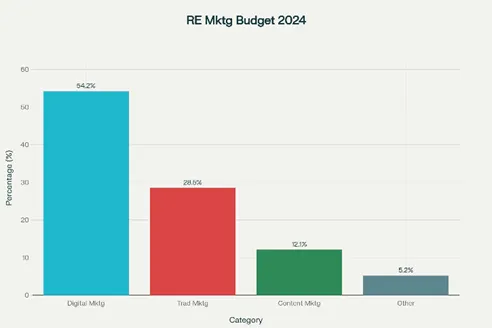
What This Chart Reveals
This bar chart displays how real estate professionals allocate their marketing budgets across four channels:
- Digital Marketing: 54.2% (largest segment)
- Traditional Marketing: 28.5% (second largest)
- Content Marketing: 12.1% (smaller segment)
- Other: 5.2% (smallest segment)
What This Data Shows
This chart reveals a seismic shift in how the real estate industry distributes marketing spend. More than half of all real estate marketing budgets now flow to digital channels — a dramatic change from just 5–7 years ago when budgets were nearly evenly split between digital and traditional methods.
Key Insights
1. Digital Dominance: 54.2% of Budgets
Digital marketing now captures more than half of all real estate marketing budgets. This includes:
- Google Ads (search and display)
- Facebook and Instagram advertising
- SEO and organic search optimization
- Email marketing
- Website design and optimization
- Social media marketing
Why digital is winning:
- Targeted reach: Digital channels allow hyper-specific audience targeting by location, demographics, and behavior
- Measurability: Every rupee spent is trackable to leads and sales
- ROI focus: Digital delivers faster, measurable ROI compared to traditional methods
- Mobile advantage: Digital reaches users on smartphones (where 72.5% of property searches happen)
- Cost efficiency: Digital often delivers lower cost-per-lead than traditional methods
- Real-time optimization: Campaigns can be adjusted instantly based on performance data
Practical implication: If you’re hiring an agency that isn’t allocating at least 50% of your budget to digital channels, you’re potentially missing out on superior returns.
2. Traditional Marketing Still Relevant: 28.5%
While declining, traditional marketing still captures 28.5% of budgets. This includes:
- Hoardings and billboards
- Newspaper and magazine advertisements
- Direct mail
- Outdoor advertising
- Events and activations
Why traditional isn’t dead:
Traditional marketing remains important for:
- Brand visibility: Hoardings on highways build brand awareness among commuters
- Mass market projects: Reaching broader audiences for affordable housing projects
- Flagship launches: Premium projects often use high-impact traditional campaigns
- Credibility building: Newspaper ads signal legitimacy and establishment
- Geographic targeting: Neighborhood hoardings reach local audiences
Real-world application: A mass-market residential project (₹40–50 lakh range) might allocate 40% to traditional (hoardings in residential areas) and 60% to digital. A luxury project (₹1.5–2 Cr) might allocate 20% to traditional (premium publications) and 80% to digital.
3. Content Marketing Growing: 12.1%
12.1% of budgets dedicated to content marketing represents a rapidly growing segment. Content marketing includes:
- Blog posts and articles
- Market analysis reports
- Buyer guides and educational content
- Video content (tours, market insights, testimonials)
- E-books and downloadable resources
- Neighborhood guides and market trends
Why content marketing is expanding:
- SEO compound effect: Blog posts rank on Google indefinitely; benefits accumulate over time
- Authority building: Comprehensive content establishes expertise and trust
- Buyer education: Buyers want information before making ₹1+ crore decisions
- Evergreen assets: Market analysis content remains relevant for years
- Low cost at scale: Initial creation cost is amortized across years of traffic
Future trend: Content marketing budget allocation is expected to increase to 15–18% within 2–3 years as agencies recognize its compounding value.
4. Other Channels: 5.2%
5.2% covers emerging and experimental channels:
- Influencer partnerships
- Podcasts and audio content
- Webinars and virtual events
- Partnership marketing
- Affiliate programs
- Experiential marketing
What This Means for Your Agency Selection
When evaluating an agency, ask:
- “How do you allocate budget across channels?” A sophisticated agency should explain budget allocation based on your specific situation.
- “Why are you recommending this specific allocation?” Red flag if they can’t justify their recommendation with data.
- “What’s the budget split between paid (ads) vs owned (email, website) vs earned (SEO, organic social)?” This reveals whether they have a balanced, integrated approach.
- “Do you shift budget allocation based on performance?” Real agencies optimize constantly, moving budget to higher-performing channels.
- “Can you show me budget allocation examples for similar projects?” Case studies reveal their thinking.
Graph 2: Conversion Rate Comparison Across Real Estate Marketing Channels
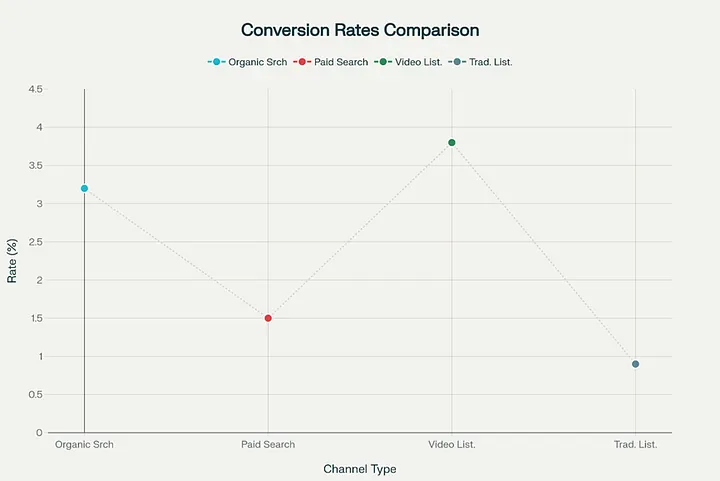
What This Chart Reveals
This bar chart compares conversion rates across four real estate marketing channels:
- Video Listings: 3.8% (highest conversion)
- Organic Search: 3.2% (strong conversion)
- Paid Search (Google Ads): 1.5% (moderate conversion)
- Traditional Listings (no video): 0.9% (lowest conversion)
What This Data Shows
This chart demonstrates one of the most significant findings in real estate marketing: the dramatic impact of video content on conversion rates. Properties with video content convert at 4.2 times the rate of properties without video.
Key Insights
1. Video Content’s Transformative Power: 3.8% Conversion
Listings with video achieve a 3.8% conversion rate — meaning approximately 4 out of every 100 property viewers take a desired action (inquiry, site visit booking, contact submission).
Why video converts so effectively:
- Eliminates uncertainty: Buyers see the actual property, not their imagination. They evaluate scale, layout, lighting, views, condition
- Emotional connection: Video creates feeling and lifestyle association that static photos cannot
- Faster decision-making: Buyers quickly determine if a property matches their needs
- Confidence building: Buyers arrive for site visits already familiar with the property, reducing no-shows
- Social amplification: Video content gets shared 2–3x more than photos, reaching broader audiences
- Immersive experience: Video feels like a virtual tour, reducing buyer hesitation
Without video:
- Monthly property views: 500 (from ads, listings, organic)
- Conversion rate: 0.9%
- Monthly inquiries: 4.5
- Conversion to site visits: 50%
- Monthly site visits: 2.25
- Conversion to booking: 20%
- Monthly bookings: 0.45 (less than 1 every 2 months)
With professional video:
- Monthly property views: 1,500+ (video gets more shares)
- Conversion rate: 3.8%
- Monthly inquiries: 57
- Conversion to site visits: 50%
- Monthly site visits: 28.5
- Conversion to booking: 20%
- Monthly bookings: 5.7 (more than 1 per week!)
Impact: Video implementation increases monthly bookings from 0.45 to 5.7 — more than 10x improvement. One additional booking at 1% commission on ₹1.8 Cr = ₹1.8 Lakh additional commission per booking. Monthly uplift: ₹8+ Lakhs.
Video production cost: ₹25,000-₹40,000 for professional property video
Payback period: 3–5 days
This explains why Gurgaon’s most successful luxury realtors now treat video as mandatory, not optional.
2. Organic Search Performs Strongly: 3.2% Conversion
Organic search (Google results from SEO) converts at 3.2% — nearly as well as video and the second-highest conversion rate.
Why organic search converts so effectively:
- High buyer intent: Users actively searching “2 BHK apartments Gurgaon” or “luxury homes Sector 80” are seriously considering purchase
- Trust factor: Organic results feel more neutral and trustworthy than paid advertisements
- Qualified traffic: Only genuinely interested buyers reach your site through targeted keywords
- Lower customer acquisition cost: While initial SEO investment is high (₹40,000-₹100,000 to establish rankings), cost-per-lead eventually becomes very low as rankings improve (₹500-₹2,000 per lead after 6–12 months)
- Compounding benefit: Rankings compound and improve over time; unlike ads that stop when you stop spending
Market data: Organic search drives 53% of real estate website traffic, making it the #1 traffic source despite competitive keyword landscape.
Strategic implication: Agencies that invest in SEO early build long-term competitive advantages. After 6–12 months of SEO investment, organic search often becomes your highest-ROI channel.
3. Paid Search Underperforms: 1.5% Conversion
Google Ads (pay-per-click) convert at 1.5% — half the rate of organic search and less than half the rate of video.
Why PPC conversion rates are lower:
- Broader audience: Google Ads reach users at various stages of buyer journey, not just active researchers
- Ad skepticism: Users increasingly skip ads to go directly to organic results
- Mobile challenges: 72.5% of traffic is mobile; mobile users have lower conversion rates on ads due to accidental clicks and smaller screens
- Ad fatigue: Users increasingly ignore ads as they become ubiquitous
- Trust perception: Some users view ads as “commercial” while trusting organic results as “neutral”
However, PPC remains valuable for:
- Time-sensitive campaigns: New project launches need immediate visibility (before 6 months of SEO rankings build)
- Keyword domination: Your ads appear instantly while SEO rankings develop
- Testing capability: A/B test messaging, offers, and creative quickly before investing in long-term SEO
- Local campaigns: Geo-targeted ads reach buyers in specific neighborhoods
- Seasonal peaks: Capture high-intent traffic during peak buying seasons
Strategic implication: Most successful real estate campaigns use PPC for immediate results (months 1–6) while building SEO for long-term advantage (months 6–18+).
4. Traditional Listings Dramatically Underperform: 0.9% Conversion
Properties listed without video convert at less than 1% — 4 times lower than video listings.
This represents the old approach:
- Basic smartphone photos
- Vague text descriptions
- Generic presentation
- Buyer must imagine the space
Why non-video listings underperform:
- Buyer hesitation: Lack of visual detail creates uncertainty
- Quick dismissal: Buyers scroll past quickly without engagement
- Lower trust: Professional visuals signal legitimacy; poor visuals signal indifference
- Mobile unfriendliness: Poorly optimized images don’t display well on smartphones (where 72.5% of views occur)
- Social media death: These listings get no shares, limiting reach
In Gurgaon’s competitive market, particularly for premium properties, a listing without video is nearly invisible against video-enabled competitors.
What This Means for Your Agency Selection
Critical questions to ask:
- “What’s your video production process and timeline?” Real answer: In-house team or trusted partner; turnaround 5–10 days.
- “Can you show conversion rate improvements for properties pre-video vs post-video?” Agency should have case studies.
- “What’s your typical video production cost?” Transparent pricing: ₹10,000-₹50,000 depending on property type and quality.
- “How do you optimize video for different platforms?” Videos should be optimized for website, YouTube, Facebook, Instagram, WhatsApp.
- “Do you use 3D tours in addition to video?” Next-level agencies offer both video + 3D for immersive experience.
Red flags:
- “Video is too expensive” (likely means they lack in-house capability)
- Can’t show conversion rate improvements from video implementation
- No video portfolio or examples
- Treats video as “optional add-on” rather than foundational
Real-World Application for Gurgaon Properties
Luxury Property Strategy (₹1.5 Cr+):
- Invest in professional video (₹30,000-₹50,000)
- Include drone footage showing location context and surrounding area
- Create 3D virtual tour for immersive exploration
- Produce lifestyle video showcasing community amenities
- Expected conversion lift: 300–400% (0.9% → 3.8%+)
- ROI: Single additional booking covers video cost 1000x
Mid-Premium Property (₹75-₹100 Lakhs):
- Professional video (₹10,000-₹15,000)
- Quick property walkthrough (2–3 minutes)
- Expected conversion lift: 250–300%
- ROI: Highly positive on mid-ticket properties
Mass Market Property (Sub-₹50 Lakhs):
- Smartphone video walkthrough or agent self-recorded (₹500-₹2,000)
- Even basic video dramatically outperforms no video
- Expected conversion lift: 300%+ (0.9% → 3%+)
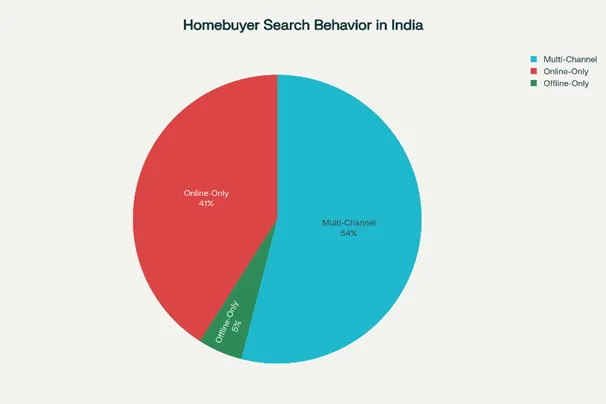
What This Chart Reveals
This pie chart displays how homebuyers in India approach their property search across three distinct channels:
- Multi-Channel (Online + Offline): 54% (largest segment)
- Online-Only: 41% (second largest, growing rapidly)
- Offline-Only: 5% (smallest, declining segment)
What This Data Shows
This chart reveals a fundamental truth about modern property buying: the vast majority of Indian homebuyers rely on digital channels. 95% of buyers use online research (either multi-channel or online-only), while only 5% stick to traditional offline methods.
Key Insights
1. Multi-Channel Dominance: 54%
More than half of homebuyers combine online and offline research methods, creating an integrated buying journey.
Online components of multi-channel approach:
- Initial research on property portals (99acres, MagicBricks, Housing.com)
- Google searches for specific properties and neighborhoods
- Social media exploration (Instagram, Facebook, YouTube)
- WhatsApp communication with agents
- Virtual tours and video walkthroughs
- Price comparison across multiple sites
- Reading reviews and testimonials
Offline components:
- Site visits to view property in person (typically 2–3 visits)
- Meetings with agents and brokers
- Conversations with neighbors and existing residents
- Legal documentation review
- Bank and financial consultation
- Professional property inspection
Why multi-channel buyers are sophisticated:
These buyers conduct extensive due diligence:
- Research 6–8 months before making decision
- View 3–4 properties before booking
- Visit each property multiple times
- Involve family in decision process
- Verify all details before committing
Marketing implications for multi-channel buyers:
Your online presence must be exceptional because these buyers are reading your website, reviews, and social media before committing to a site visit.
- Website must be: Professional, fast-loading, mobile-friendly
- Video content is critical: They’ve watched 3–4 property videos before calling
- Follow-up is essential: They’re comparing your property to 2–3 others
- Testimonials are influential: They’re reading feedback from other buyers before deciding
Recommended strategy: Create exceptional online experience that educates buyers thoroughly, so when they arrive for site visit, they’re already convinced.
2. Online-Only Buyers: 41%
An increasingly significant and growing segment — 41% of homebuyers — conduct their entire property search exclusively online without any physical site visits initially.
Who are online-only buyers?
- NRIs investing long-distance: Buying investment properties in Gurgaon without visiting
- Young professionals (25–35): Tech-savvy, comfortable with digital transactions
- First-time buyers: Intimidated by traditional sales agents; prefer digital research
- Busy working professionals: Limited time; research in evenings and weekends
- Systematic investors: Analyzing markets systematically, may visit multiple properties simultaneously
- Digital natives: Gen-Y and millennial buyers who expect complete digital experiences
What online-only buyers do:
- Extensive website research (spend 30–60 minutes per property)
- Multiple virtual tours and 3D walkthroughs
- Detailed video analysis (watch property videos 2–3 times)
- Online consultation with agents via WhatsApp or video call
- Research neighborhood via Google Maps Street View and YouTube
- Read extensive online reviews and testimonials
- Potentially make booking decision without physical visit (especially for plots and investment properties)
- Request drone footage, neighborhood videos, and street-level exploration videos
Growing segment in Gurgaon:
In Gurgaon specifically, online-only buyer percentage is even higher:
- Gurgaon online-only buyers: 45% (vs 41% national average)
- Reasons: Tech-savvy population, NRI concentration, younger demographics
Marketing implications for online-only buyers:
Your website is your primary sales tool. Every detail must be online.
- Website must have: Comprehensive information, detailed floor plans, neighborhood maps, investment analysis
- Video is mandatory: Professional 3–4 minute property tour video
- 3D tours are highly valuable: Interactive exploration without time pressure
- Virtual consultation must work: Live video calls with agents, WhatsApp responsiveness
- Payment information online: They want to research financing options without calling
- Location details crucial: Detailed information on schools, transport, hospitals, malls nearby
Recommended strategy: Provide so much detailed, accurate online information that buyer can make informed decision without site visit (if they wish).
3. Offline-Only Buyers: 5%
A shrinking segment — only 5% of homebuyers rely solely on offline methods:
Who are these buyers?
- Older generation, less comfortable with technology
- Local buyers with established relationships with agents
- Those buying from personal contacts or referrals
- Buyers in smaller cities/towns with limited online content
Market trend: This segment is shrinking as digital adoption increases, particularly in metros like Gurgaon where 65%+ of buyers are highly tech-savvy.
Distribution Analysis Specific to Gurgaon
In Gurgaon’s market, the distribution skews even more digital:
Gurgaon Buyer Breakdown (estimated):
- Multi-Channel (online + offline): 50%
- Online-Only: 45%
- Offline-Only: 5%
Critical insight: Approximately 95% of Gurgaon buyers use online channels significantly, making digital marketing non-negotiable for any property business.
For comparison:
- Tier-2 cities: 70% use online (lower percentage)
- Tier-3 cities: 50% use online (much lower)
- Gurgaon: 95% use online (extremely high)
This reflects Gurgaon’s highly educated, tech-savvy, often internationally-mobile buyer demographic.
What This Means for Your Agency Selection
Your agency must understand and serve all three segments:
- “What’s your multi-channel strategy?” Answer should include: online presence + offline sales support
- “How do you serve online-only buyers?” Answer should include: 3D tours, virtual consultation, comprehensive online information
- “What percentage of your clients’ leads are online vs offline?” Should show 80%+ online for Gurgaon properties
- “How do you optimize for both desktop (longer research sessions) and mobile (quick browsing)?” Should show understanding of different user behaviors
- “Can you handle NRI buyers buying long-distance?” Should have process for virtual meetings, international payments, etc.
Red flags:
- Only focuses on offline traditional sales
- Doesn’t understand online-only buyer behavior
- No 3D tour or virtual consultation capability
- Website doesn’t work well for research phase
- Can’t explain multi-channel strategy
Frequently Asked Questions (FAQ) — Real Estate Digital Marketing Gurgaon
1. Why is digital marketing crucial for real estate businesses in Gurgaon?
Digital marketing allows property firms to target high-intent buyers and investors where they increasingly search — online. With 96% of homebuyers now starting their property search online, digital channels like SEO, social media marketing, and Google Ads have become non-negotiable for generating quality leads, boosting online presence, and achieving quicker sales.
2. Which channels work best for property lead generation in Gurgaon?
A strategic mix of digital channels works best:
- SEO for “ready to move flats in Gurgaon” and similar local keywords.
- Google and Meta Ads for hyper-local targeting and project launches.
- WhatsApp and email nurturing for follow-ups.
- Social media branding on Facebook, Instagram, and YouTube.
Performance marketing and properly optimized landing pages can increase lead inquiries by up to 4.5x compared to traditional methods.
3. What does a real estate digital marketing agency do, exactly?
A specialized agency manages everything from website design, SEO, and paid ad campaigns to content creation, lead funnel integration, and WhatsApp/CRM automation. The goal: drive targeted buyers to your listings, capture their details, nurture leads, and book site visits — while providing ROI-driven analytics and strategy refinement.
4. How do I know if my agency is delivering ROI?
Agencies should provide a transparent dashboard with weekly/monthly reports including:
- Number and source of leads
- Cost per lead/click/booking
- Channel performance (SEO/paid/social)
- Website traffic, bounce rates, and conversions
- Recommendations for continual improvement
A credible agency will always tie performance metrics to your sales pipeline and revenue results, not just “impressions.”
5. How quickly can I expect results from real estate digital marketing?
- Paid Ads: Inquiries can start in days if the campaign and landing page are optimized.
- SEO: Rankings and traffic often show significant improvement in 3–6 months.
- Social Media: Noticeable engagement in 3–4 weeks; strong brand impact in 2–4 months.
Long-term consistency and data-driven refinement deliver the best compounding ROI.
6. Is it necessary to use video content or 3D tours for property marketing?
Absolutely — listings with video and 3D tours see up to 4x more inquiries and nearly double the site visits compared to those without. In a premium market like Gurugram, video walkthroughs, drone shots, and virtual tours are standard for attracting serious buyers and NRI investors.
7. Which metrics should I focus on: impressions, clicks, leads, or bookings?
The most valuable metrics are:
- Cost per qualified lead
- Conversion to site visit/bookings
- Source/channel attribution
Impressions and clicks show reach, but leads and bookings drive your ROI. Always ask for precise tracking and channel benchmarking from your agency.
8. How important is mobile optimization for a real estate website in Gurugram?
Incredibly important — up to 80% of Gurgaon buyers now use mobile for property searches. Mobile-optimized, lightning-fast websites with easy WhatsApp/call CTAs dramatically increase lead captures and conversions.
9. Can I target NRI buyers or HNIs with digital marketing?
Yes. Targeted campaigns on LinkedIn, YouTube, Facebook, and Google Display, along with international SEO and virtual consultation tools, are highly effective for NRIs and high-net-worth buyers. Over 90% of NRI and HNI buyers rely on digital channels for preliminary research.
10. How does digital marketing help with reputation and testimonials?
Integrated reputation management tools can collect, publish, and reply to reviews across Google, Facebook, and property portals. Positive testimonials, case studies, and video reviews build essential trust and increase conversion rates — especially among the premium and investor segments.
Whether you’re marketing luxury flats, plotting residential projects in Gurgaon, or promoting resorts near Manesar, your digital marketing partner must know your audience, location, and language. Asking these five questions ensures you work with a team that understands real estate growth, buyer psychology, and local Gurugram keywords deeply — turning clicks into actual property buyers.
Conclusion: Choosing the Right Digital Partner in Gurugram
Whether you’re marketing luxury flats, plotting residential projects in Gurgaon, or promoting resorts near Manesar, your digital marketing partner must know your audience, location, and language. Asking these five questions ensures you work with a team that understands real estate growth, buyer psychology, and local Gurugram keywords deeply — turning clicks into actual property buyers.